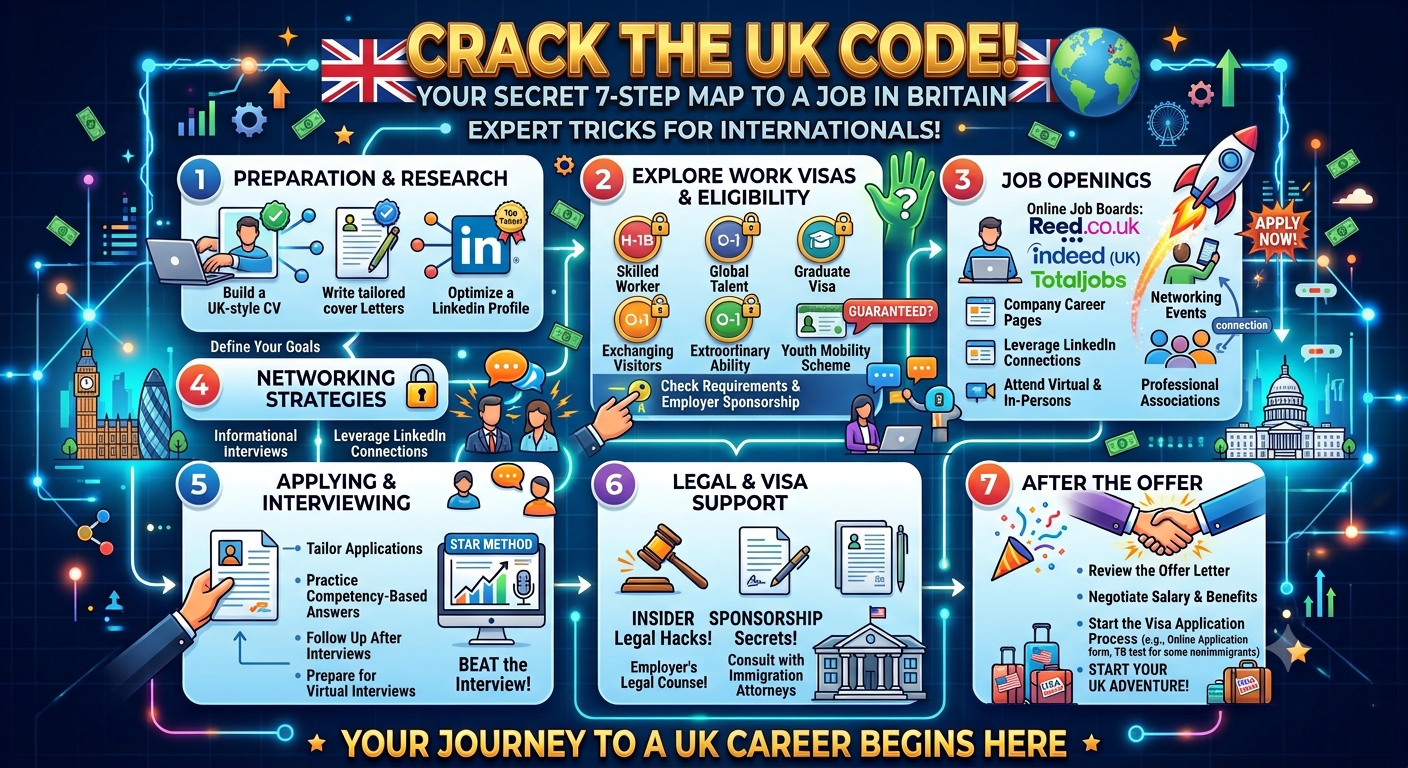
The United States remains an important destination for professionals and skilled workers from around the world. Its employment market covers a wide range of industries, from technology and healthcare to engineering, construction, logistics, finance, education, and hospitality.
For foreign workers, however, finding employment in the USA involves more than identifying a vacancy and submitting a resume. Candidates may need to meet education, experience, licensing, language, and work-authorization requirements depending on the occupation and their individual circumstances.
This guide explores jobs in USA for foreign workers, including common career options, skills employers look for, application strategies, and important considerations before accepting a position.
Can Foreign Workers Get Jobs in the USA?
Foreign workers can work in the United States when they have the appropriate employment authorization or qualify for an immigration category that permits employment.
The specific process depends on the person’s circumstances. Some workers may already have authorization to work, while others may require an employer-supported immigration process or another qualifying status.
This distinction is important because being qualified for a job does not automatically mean that a person is legally permitted to work in the United States.
Before applying extensively, international candidates should determine whether they:
- Already have U.S. work authorization
- Need an employer to support an immigration process
- Need a professional or occupational license
- Have educational credentials that meet the position’s requirements
- Meet the employer’s experience requirements
Current immigration and employment rules should always be verified through official U.S. government sources because requirements and procedures can change.
What Makes a Job Suitable for Foreign Workers?
There is no single category of jobs that automatically qualifies as a “foreign worker job.” Suitability depends on several factors.
A position may be particularly relevant to international candidates when it requires specialized skills, professional qualifications, technical expertise, or experience that employers actively seek.
Important factors include:
- Employer recruitment practices
- Occupation and industry
- Candidate qualifications
- Work authorization
- Professional licensing
- Experience level
- Location
- Demand for specific skills
International candidates should therefore research individual employers rather than assuming that an entire industry provides sponsorship or international recruitment.
1. Software and Technology Jobs
Technology is one of the most internationally connected areas of the U.S. employment market.
Potential career paths include:
- Software developer
- Web developer
- Data analyst
- Data engineer
- Cloud engineer
- Cybersecurity specialist
- Systems administrator
- Database administrator
- Machine learning engineer
- IT support specialist
- DevOps engineer
Skills Employers May Look For
Depending on the role, employers may value:
- Programming languages
- Database management
- Cloud technologies
- Cybersecurity knowledge
- Software development practices
- Data analysis
- Problem-solving
- Communication
- Project experience
A strong portfolio can also be valuable for certain technology positions.
Candidates can demonstrate their skills through professional projects, Git repositories, technical portfolios, certifications, or previous employment.
2. Healthcare Jobs
Healthcare is another major employment sector in the United States.
Potential roles include:
- Registered nurses
- Medical technicians
- Healthcare administrators
- Physical therapists
- Medical laboratory professionals
- Medical assistants
- Pharmacists
- Physicians
- Healthcare technology professionals
Healthcare occupations often have specific educational, examination, certification, or licensing requirements.
Foreign-trained healthcare professionals should investigate credential evaluation and professional licensing requirements before assuming that their existing qualification can be used directly in the United States.
Important Skills
Healthcare employers may look for:
- Clinical knowledge
- Patient-care skills
- Communication
- Technical competence
- Professional ethics
- Documentation skills
- Teamwork
- Relevant certifications or licenses
Because healthcare is regulated, candidates should check the requirements applicable to their particular occupation and state.
3. Engineering Jobs
Engineering offers career opportunities across numerous industries.
Foreign engineers may find positions in areas such as:
- Civil engineering
- Mechanical engineering
- Electrical engineering
- Industrial engineering
- Chemical engineering
- Environmental engineering
- Manufacturing engineering
- Software engineering
Requirements depend on the position.
Some employers may prioritize a bachelor’s or master’s degree in engineering, professional experience, software knowledge, technical certifications, or industry-specific expertise.
Useful Engineering Skills
Employers may value:
- CAD and engineering software
- Project management
- Technical documentation
- Data analysis
- Problem-solving
- Quality control
- Safety knowledge
- Communication
- Industry-specific technical expertise
For regulated engineering activities, licensing requirements can also matter.
4. Construction and Skilled Trades
The U.S. construction industry includes a broad range of occupations.
Examples include:
- Construction laborers
- Electricians
- Plumbers
- HVAC technicians
- Welders
- Carpenters
- Equipment operators
- Construction supervisors
- Estimators
- Project managers
Requirements vary considerably.
Some positions may focus primarily on practical experience and technical skills, while others require formal education, certifications, or licenses.
Foreign workers with trade experience should investigate whether their qualifications transfer to the state or employer where they want to work.
5. Logistics and Transportation Jobs
The logistics industry supports manufacturing, retail, e-commerce, healthcare, and many other sectors.
Possible occupations include:
- Warehouse associate
- Logistics coordinator
- Supply chain specialist
- Inventory specialist
- Operations coordinator
- Truck driver
- Fleet coordinator
- Transportation manager
Technology has also changed logistics work, increasing demand for people who understand inventory systems, warehouse management software, data analysis, and supply-chain processes.
Transportation jobs can have additional licensing requirements, so candidates should review the rules that apply to the specific occupation.
6. Finance and Accounting Jobs
Financial services and accounting provide opportunities for candidates with relevant educational backgrounds and professional experience.
Potential positions include:
- Accountant
- Financial analyst
- Auditor
- Tax specialist
- Risk analyst
- Financial manager
- Bookkeeper
- Business analyst
International applicants may benefit from understanding U.S. accounting practices, taxation concepts, financial reporting standards, and relevant software.
Professional certifications can also be useful depending on the career path.
7. Hospitality and Tourism Jobs
The hospitality sector includes hotels, restaurants, resorts, travel businesses, event companies, and related services.
Potential positions include:
- Hotel staff
- Front-desk employees
- Restaurant employees
- Chefs
- Food-service managers
- Housekeeping staff
- Event coordinators
- Hospitality managers
Communication and customer-service skills are particularly important.
International workers who speak multiple languages may also have opportunities in positions where communication with international customers is important.
However, applicants should carefully verify the employment authorization requirements associated with any particular position.
8. Education and Teaching Careers
Education offers a range of career paths, including:
- Teachers
- University instructors
- Researchers
- Academic administrators
- Education technology specialists
- Teaching assistants
Requirements vary by institution and occupation.
School teaching positions can involve state-specific certification requirements, while universities may have different education and experience expectations.
International educators should research the credential-recognition and licensing rules applicable to the state and institution where they intend to work.
9. Scientific and Research Careers
The United States has a large research and scientific ecosystem covering universities, laboratories, healthcare organizations, technology companies, and specialized industries.
Potential careers include:
- Research scientist
- Laboratory technician
- Biostatistician
- Research assistant
- Environmental scientist
- Data scientist
- Biomedical researcher
Advanced education can be important for some research positions, while laboratory and technical roles may have different requirements.
Candidates should highlight research experience, publications, technical methods, laboratory skills, data analysis, and relevant academic achievements where appropriate.
10. Business and Management Jobs
Experienced international professionals may also find opportunities in business-related positions.
Examples include:
- Project manager
- Operations manager
- Business analyst
- Marketing specialist
- Sales manager
- Product manager
- Human resources specialist
- Management consultant
Employers often look for a combination of industry experience, communication, analytical ability, leadership, and organizational skills.
Skills That Can Help Foreign Workers Compete for U.S. Jobs
Regardless of the industry, certain transferable skills are useful across many occupations.
English Communication
Professional communication is important for interviews, meetings, documentation, customer interactions, and teamwork.
Candidates should be comfortable explaining their experience clearly and professionally.
Digital Skills
Basic digital skills are increasingly important across industries.
Depending on the profession, this may include:
- Microsoft Office
- Google Workspace
- Data tools
- Industry-specific software
- Collaboration platforms
- Customer relationship management systems
- Enterprise software
Problem-Solving
Employers often want employees who can identify problems, evaluate options, and implement practical solutions.
Instead of simply listing “problem-solving” on a resume, demonstrate it through specific examples.
Adaptability
International workers may need to adapt to different workplace practices, communication styles, regulations, technologies, and organizational structures.
Demonstrating successful adaptation in previous roles can strengthen a professional profile.
How Foreign Workers Can Find U.S. Jobs
A structured job search can make the process more manageable.
Start by identifying your target occupation and preferred locations.
Then:
- Prepare a U.S.-focused resume.
- Create a professional online profile.
- Research employers in your industry.
- Search established job platforms.
- Check official employer career pages.
- Review work-authorization requirements.
- Customize applications.
- Keep track of applications.
- Prepare for interviews.
- Verify employment and immigration information.
How to Improve Your Resume for U.S. Employers
A strong resume should be concise and relevant.
Focus on:
- Professional experience
- Relevant skills
- Measurable accomplishments
- Education
- Certifications
- Projects
- Technical expertise
Avoid copying a generic resume for every application.
If a position emphasizes cloud computing, for example, relevant cloud experience should be easy for the recruiter to find.
If a construction position emphasizes safety and project supervision, highlight relevant experience rather than unrelated skills.
Salary Considerations for Foreign Workers
Salary varies significantly by occupation, location, experience, employer, and industry.
Two people with the same job title can have substantially different compensation because they work in different locations or industries.
When researching salaries, look at:
- Base pay
- Hourly versus annual compensation
- Overtime
- Bonuses
- Commission
- Benefits
- Retirement contributions
- Paid leave
- Local cost of living
Salary should therefore be evaluated alongside the complete compensation package and living expenses.
Work Authorization and Sponsorship
One of the most important issues for international candidates is work authorization.
An employer may advertise a position that looks suitable based on qualifications, but the candidate may still need appropriate authorization to work.
Some employers may consider sponsorship in particular circumstances, while others may require applicants to already have authorization.
Do not assume that a company sponsors every position simply because it has hired international employees in the past.
Read the job description carefully and, when appropriate, ask the employer or recruiter about the position’s eligibility requirements.
Beware of Job Scams
International job seekers can be targeted by fraudulent employment offers.
Warning signs may include:
- Requests for large upfront payments
- Guaranteed employment claims
- Unusually high compensation for minimal qualifications
- Requests for sensitive financial information before legitimate hiring steps
- Communication from unofficial email addresses pretending to represent a company
- Pressure to make immediate payments
- Requests to purchase equipment from an unknown supplier
Always verify the company independently.
Visit the employer’s official website and compare the vacancy with its official careers information.
Final Checklist for Foreign Workers
Before applying for a U.S. position, ask yourself:
Qualification:
Do I meet the educational and professional requirements?
Experience:
Can I demonstrate relevant experience?
Skills:
Do my technical and transferable skills match the vacancy?
Resume:
Does my resume clearly communicate my relevant achievements?
Work authorization:
Do I have the required authorization, or does the position have a pathway that may apply to my situation?
Location:
Have I researched the cost of living and employment environment?
Employer:
Have I independently verified the company and vacancy?
Interview:
Can I clearly explain my experience and professional goals?
Frequently Asked Questions
What are some common jobs in the USA for foreign workers?
Foreign workers may pursue opportunities in technology, healthcare, engineering, construction, logistics, finance, education, hospitality, scientific research, and other industries. Eligibility depends on the occupation, employer, qualifications, and work authorization.
Do foreign workers need a U.S. degree?
Not necessarily. Some employers accept relevant international qualifications and professional experience. However, regulated professions may have specific credential, examination, or licensing requirements.
Can foreign workers apply for U.S. jobs from their home country?
Yes. Many employers accept online applications from international candidates. Whether an applicant can ultimately be employed depends on the employer’s hiring practices and the candidate’s work authorization.
Which skills should international job seekers develop?
The most useful skills depend on the occupation. Technical expertise, professional communication, digital skills, problem-solving, industry knowledge, and relevant certifications can all be valuable.
Is visa sponsorship guaranteed for foreign workers?
No. Sponsorship depends on the employer, position, candidate, and applicable immigration rules. Job seekers should verify the specific requirements rather than relying on general claims.
Conclusion
Finding jobs in USA for foreign workers requires careful planning. The best opportunity for one international candidate may be completely different from the best opportunity for another because qualifications, experience, occupation, location, and work authorization all affect employment options.
Technology, healthcare, engineering, construction, logistics, finance, education, research, hospitality, and business are among the major areas international candidates can explore. However, every occupation has its own requirements, and regulated professions may require additional licensing or credential recognition.
For a successful U.S. job search in 2026, focus on three fundamentals: match your skills to genuine employer requirements, prepare a professional application, and verify your work-authorization options before making major career or relocation decisions.
A well-researched and targeted approach can help international professionals navigate the U.S. employment market more effectively while avoiding common application mistakes and fraudulent job offers.