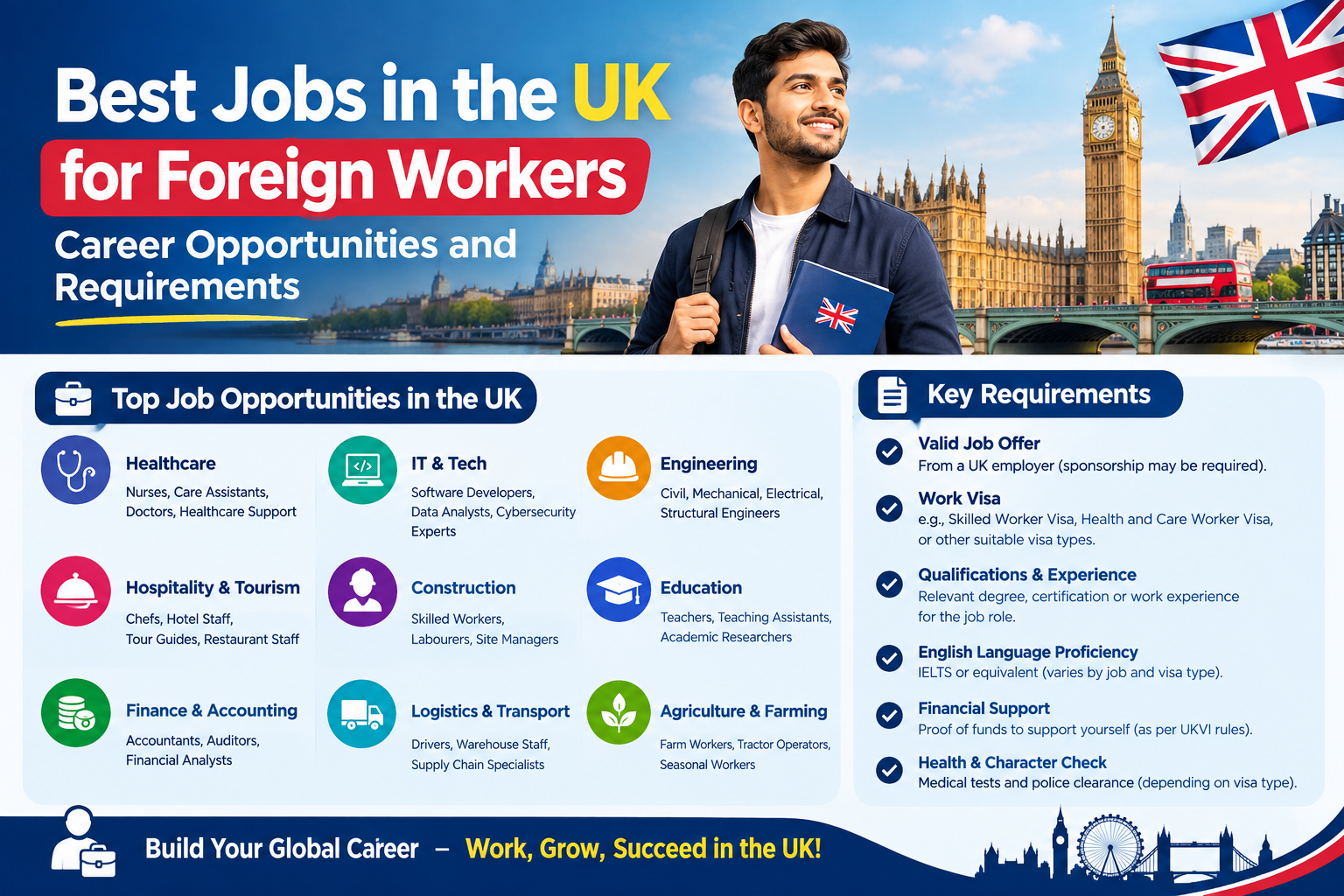
The United Kingdom continues to attract professionals and skilled workers from around the world. Its employment market covers technology, healthcare, engineering, finance, construction, education, logistics, scientific research, hospitality, and many other industries.
For people living outside the UK, however, finding a suitable job involves more than searching for vacancies and sending applications. International candidates need to consider qualifications, professional experience, English-language ability, salary requirements, occupation eligibility, employer sponsorship, and, where applicable, professional registration or licensing.
This guide explains some of the major jobs in the UK for foreign workers, the skills employers commonly look for, and the key requirements international applicants should understand when planning a UK career in 2026.
Can Foreign Workers Work in the UK?
Yes, foreign nationals can work in the UK, but the requirements depend on their immigration status and the type of work they intend to undertake.
For people who need a Skilled Worker visa, the job generally needs to be eligible, the employer needs to be approved by the Home Office, and the applicant needs a Certificate of Sponsorship. Salary and other eligibility requirements also apply.
This means that finding a vacancy is only one part of the process. An international applicant should also determine whether their particular job, employer, salary, and personal circumstances satisfy the applicable immigration rules.
UK immigration rules can change, so candidates should check the latest official guidance before making relocation or employment decisions.
1. Healthcare Jobs
Healthcare is one of the most important career areas for international professionals in the UK.
Potential occupations include:
- Doctors
- Nurses
- Medical practitioners
- Biomedical scientists
- Laboratory professionals
- Healthcare managers
- Physiotherapists
- Radiographers
- Other regulated healthcare professionals
The exact requirements depend on the occupation.
Healthcare professionals may need appropriate qualifications, professional registration, relevant experience, and evidence that they meet the standards of the relevant UK regulator.
The UK government maintains specific guidance covering healthcare and education occupations that are eligible under the Skilled Worker route.
Skills That Can Help
Healthcare employers may value:
- Clinical knowledge
- Patient-care skills
- Communication
- Teamwork
- Medical documentation
- Technical competence
- Professional ethics
- Relevant registration and certifications
Foreign-trained healthcare professionals should investigate recognition of their qualifications and registration requirements before applying for positions.
2. Information Technology and Software Jobs
Technology is another major career area for international professionals.
Potential jobs include:
- Software developer
- Software engineer
- Web developer
- Data analyst
- Data scientist
- Cybersecurity specialist
- Cloud engineer
- DevOps engineer
- Database administrator
- IT support specialist
- Systems administrator
The requirements vary according to the position and employer.
A technology candidate may strengthen their application by demonstrating programming knowledge, software development experience, cloud skills, database knowledge, cybersecurity expertise, or relevant professional projects.
Important Technology Skills
Depending on the role, employers may look for:
- Python
- Java
- JavaScript
- SQL
- Cloud platforms
- Cybersecurity
- Data analysis
- Software testing
- DevOps
- Database management
Candidates should focus on the technologies actually mentioned in the job description rather than adding a long list of unrelated skills.
3. Engineering Careers
Engineering provides opportunities across several industries in the UK.
Common areas include:
- Civil engineering
- Mechanical engineering
- Electrical engineering
- Electronics engineering
- Chemical engineering
- Manufacturing engineering
- Environmental engineering
- Software engineering
International engineers may need a relevant degree, professional experience, technical knowledge, and, depending on the position, professional registration or other credentials.
Useful Engineering Skills
Employers may value:
- Computer-aided design
- Technical analysis
- Project management
- Quality control
- Engineering software
- Problem-solving
- Technical documentation
- Health and safety awareness
- Communication
Foreign engineers should carefully check whether the role requires a particular professional qualification or registration.
4. Construction Jobs
Construction is a broad sector that includes both professional and skilled-trade occupations.
Examples include:
- Civil engineers
- Construction managers
- Site managers
- Quantity surveyors
- Building professionals
- Electricians
- Plumbers
- Carpenters
- Bricklayers
- Roofers
- Technical and architectural professionals
The eligibility of a construction job for immigration purposes depends on its specific occupation classification rather than simply the general word “construction.”
For example, the current Skilled Worker guidance distinguishes between different construction occupations. Some construction roles are eligible while construction labourer roles are treated differently.
This is an important point for international workers: always check the actual occupation code and job duties instead of relying only on a job title.
5. Finance and Accounting Jobs
The UK’s financial services sector provides careers in areas such as:
- Accounting
- Financial analysis
- Auditing
- Risk management
- Banking
- Investment services
- Taxation
- Compliance
- Business analysis
Potential positions include:
- Accountant
- Financial analyst
- Auditor
- Risk analyst
- Finance manager
- Tax specialist
- Compliance professional
- Business analyst
Relevant degrees, professional qualifications, financial software knowledge, analytical ability, and industry experience can strengthen an application.
International candidates should also research whether a particular position requires knowledge of UK-specific regulations, accounting practices, or professional standards.
6. Scientific and Research Careers
The UK has universities, research organisations, laboratories, pharmaceutical companies, technology businesses, and other organisations that employ scientific professionals.
Possible career paths include:
- Research scientist
- Laboratory technician
- Biomedical scientist
- Environmental scientist
- Data scientist
- Research assistant
- Scientific analyst
The requirements depend heavily on the role.
Some research positions require advanced degrees and research experience, while technical laboratory roles may have different educational and professional requirements.
The current UK immigration framework includes a range of scientific and technical occupations within its skilled occupation classifications.
7. Education and Teaching
Education is another area that international candidates may explore.
Potential careers include:
- Teachers
- University lecturers
- Researchers
- Academic administrators
- Education technology professionals
- Teaching and education leadership roles
Requirements differ according to the type of institution and role.
School teaching can involve specific qualification and registration requirements, while university positions may place greater emphasis on academic qualifications, research, teaching experience, and publications.
International teachers should research the recognition of their qualifications and the requirements applicable to the part of the UK where they intend to work.
8. Logistics and Supply Chain Jobs
The UK’s logistics and supply-chain industry supports retail, manufacturing, e-commerce, healthcare, food distribution, and many other sectors.
Potential positions include:
- Logistics manager
- Supply-chain specialist
- Warehouse manager
- Inventory coordinator
- Transport manager
- Operations specialist
- Procurement professional
- Supply-chain analyst
Relevant skills may include:
- Inventory management
- Data analysis
- Logistics software
- Planning
- Procurement
- Operations management
- Communication
- Problem-solving
Some logistics occupations currently appear in UK immigration-related skilled occupation lists, but eligibility depends on the exact occupation code and applicable rules.
9. Business and Management Careers
Experienced professionals can also explore business-related positions.
Examples include:
- Project manager
- Operations manager
- Business analyst
- Marketing professional
- Product manager
- Human resources specialist
- Management consultant
- Sales manager
Employers often look for a combination of professional experience, analytical thinking, communication, leadership, and industry knowledge.
International candidates should demonstrate specific achievements rather than simply listing generic management skills.
For example, explaining how you improved an operational process, managed a project, reduced costs, or increased efficiency can make professional experience easier to understand.
10. Skilled Technical Careers
Technical occupations can include electrical, engineering, laboratory, manufacturing, construction, and maintenance-related work.
The UK immigration system uses occupation codes to determine whether particular roles are eligible for the Skilled Worker route. Current government guidance includes various technical occupations, including engineering and laboratory-related roles.
Foreign workers should therefore check:
- The exact job duties.
- The occupation code.
- Whether the occupation is currently eligible.
- The employer’s sponsorship status.
- The applicable salary requirement.
- Any professional licensing or qualification requirements.
Skills UK Employers May Value
While requirements differ between professions, several transferable skills are useful across many UK workplaces.
Communication
Clear written and spoken communication is important in almost every professional environment.
International candidates should be able to explain their experience, responsibilities, achievements, and technical knowledge clearly.
Digital Skills
Digital skills are increasingly relevant across industries.
Depending on the career, this could include:
- Microsoft Office
- Data analysis
- Cloud software
- Industry-specific applications
- Customer management systems
- Enterprise software
- Collaboration tools
Problem-Solving
Employers value candidates who can identify problems and develop practical solutions.
Use real examples from previous employment or projects when demonstrating this skill.
Teamwork
Many UK workplaces involve collaboration between people from different professional and cultural backgrounds.
Experience working in teams can therefore be useful, particularly for healthcare, technology, engineering, business, and project-based roles.
Adaptability
International workers may need to adapt to different workplace practices, regulations, communication styles, and organisational cultures.
Demonstrating previous experience of adapting to new environments can strengthen an application.
Understanding UK Work Visa Requirements
For international candidates who need a Skilled Worker visa, the role must meet specific requirements.
Current UK government guidance states that applicants generally need an eligible job, a UK employer approved by the Home Office, and the required salary. A confirmed job offer is required before applying for the visa.
For the standard Skilled Worker route, the usual salary requirement is currently at least £41,700 per year or the applicable going rate for the occupation, whichever is higher. However, there are circumstances in which different salary rules can apply, including certain healthcare and education roles and some qualifying applicants.
This is why international applicants should not assume that one salary figure applies to every profession.
The occupation’s going rate and the applicant’s circumstances must be checked separately.
English-Language Requirement
Applicants on the Skilled Worker route generally need to demonstrate the required level of English unless an exemption applies.
The exact way an applicant proves English ability can depend on their circumstances. Current UK government guidance should be checked before submitting an application.
How to Find Jobs in the UK From Abroad
A structured job search can make the process much easier.
Step 1: Choose Your Occupation
Start with a profession that matches your education, experience, and skills.
Step 2: Research UK Requirements
Check whether your profession requires registration, licensing, qualification recognition, or other documentation.
Step 3: Prepare a UK-Focused CV
Highlight:
- Relevant experience
- Professional qualifications
- Technical skills
- Achievements
- Education
- Certifications
- Relevant projects
Step 4: Research Employers
Look at official company career pages and established recruitment platforms.
If you require sponsorship, investigate whether the employer is approved to sponsor workers and whether the particular position can meet the relevant immigration requirements.
Step 5: Apply Selectively
Do not send the same CV to every vacancy.
Adapt your application to the specific position and emphasize the skills requested by the employer.
Step 6: Prepare for Interviews
Be ready to discuss:
- Your professional background
- Technical skills
- Previous achievements
- Why you want the role
- Why you want to work in the UK
- Your availability
- Your work-authorisation circumstances
Salary and Cost of Living
Salary should not be considered separately from living costs.
The same annual salary can provide a very different lifestyle depending on location.
Before accepting an offer, research:
- Rent
- Transportation
- Council tax
- Utilities
- Food costs
- Healthcare-related expenses
- Commuting costs
- Local salary levels
London and other major cities can have substantially different housing and living costs from smaller towns and cities.
Also consider the complete compensation package, including:
- Base salary
- Bonus
- Pension
- Paid leave
- Employer benefits
- Overtime arrangements
Common Mistakes Foreign Job Seekers Should Avoid
Applying Without Checking Eligibility
A candidate may meet the employer’s professional requirements but still not meet immigration requirements.
Always check both.
Assuming Every Employer Sponsors Workers
Not every employer offers sponsorship, and sponsorship eligibility depends on the specific role and circumstances.
Using an Unrelated CV
A generic CV may hide the experience most relevant to the position.
Tailor it to the job description.
Ignoring Professional Registration
Healthcare, teaching, engineering, and other regulated professions can have specific requirements.
Research them before applying.
Trusting Unverified Job Offers
Be careful with recruitment messages that demand money, promise guaranteed employment, or request sensitive information before a legitimate hiring process.
Verify the employer independently through its official website and other reliable sources.
Frequently Asked Questions
What are the best jobs in the UK for foreign workers?
There is no single best job for every international applicant. Technology, healthcare, engineering, finance, scientific research, education, construction, logistics, and other skilled sectors can offer opportunities depending on qualifications and immigration eligibility.
Can foreigners get jobs in the UK without a UK degree?
A UK degree is not automatically required for every job. Employers may accept relevant international qualifications and professional experience, although specific professions can have their own recognition or registration requirements.
Do UK employers sponsor foreign workers?
Some employers are approved sponsors and may sponsor eligible positions. However, sponsorship is not automatic, and the occupation, salary, employer, and applicant must meet the applicable requirements.
What salary is required for a Skilled Worker visa?
The standard requirement is currently generally £41,700 per year or the applicable going rate, whichever is higher. Different rules can apply in certain circumstances, including some healthcare, education, and other qualifying situations.
Can I apply for UK jobs while living abroad?
Yes. International applicants can search and apply for suitable UK vacancies from outside the country. Whether they can ultimately take the position depends on the employer, job, qualifications, immigration status, and applicable work-authorisation rules.
Final Thoughts
Finding jobs in the UK for foreign workers requires a combination of career planning, targeted applications, qualification checks, and immigration research.
Healthcare, technology, engineering, construction, finance, scientific research, education, logistics, business, and technical occupations represent important areas for international candidates to investigate. However, eligibility varies by occupation, employer, salary, qualifications, and immigration route.
For 2026, one of the most important steps is to check the exact occupation code and current UK immigration requirements rather than relying on an old list of “jobs in demand.” The UK government regularly updates eligible occupations, salary requirements, and immigration rules.
A successful international job search therefore starts with a realistic match between your professional skills and the UK employer’s requirements. Once you identify suitable positions, prepare a focused CV, verify the employer, understand the work-authorisation requirements, and use official government information for immigration decisions.
That approach can help foreign workers build a more informed and practical path toward a career in the UK.