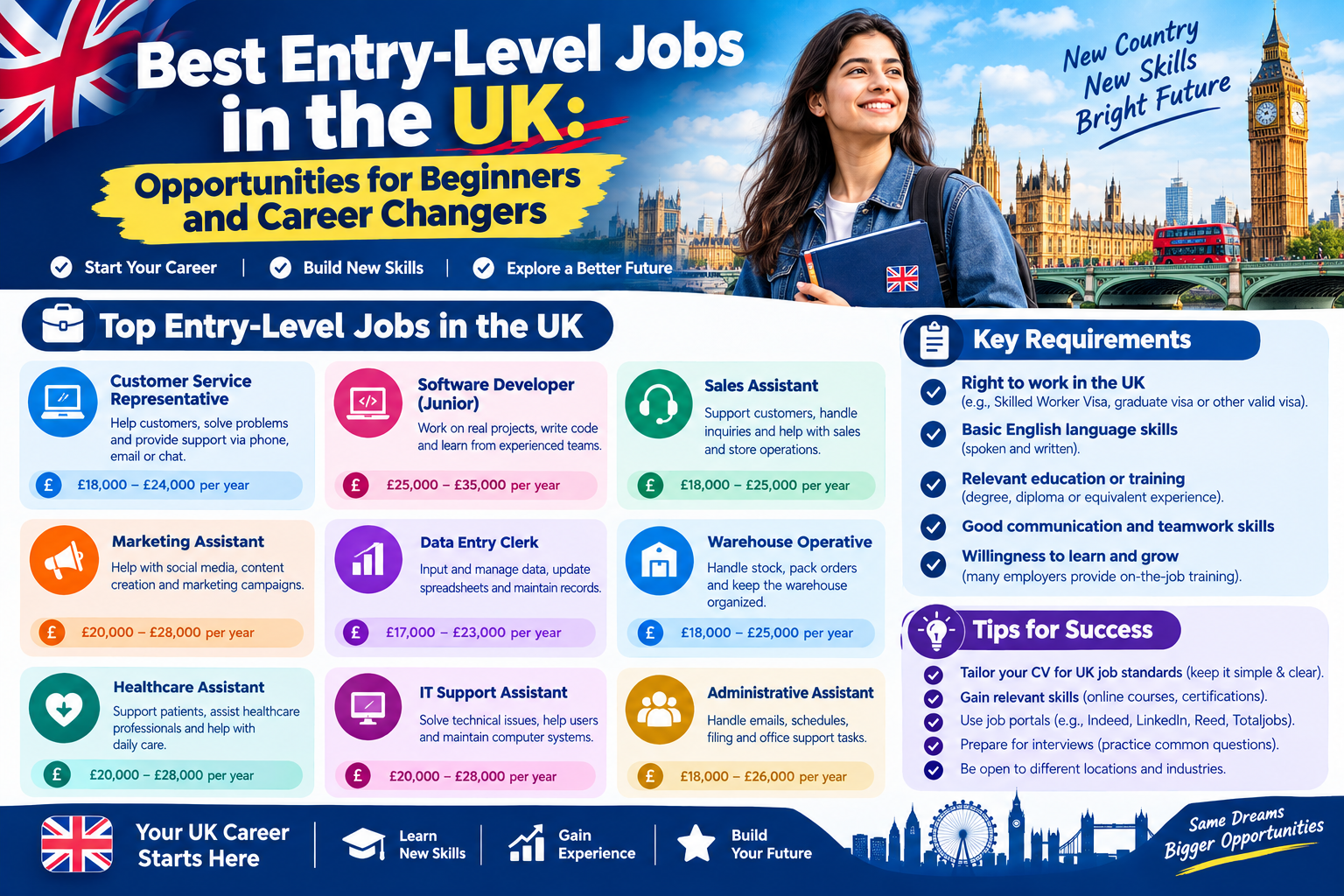
Starting your first job or changing careers can be a major decision. Many people assume that they need years of experience before they can move into a new profession, but the UK employment market includes a wide range of entry-level roles, apprenticeships, trainee positions and jobs where transferable skills can be more important than previous experience.
For beginners, entry level jobs in UK can provide an opportunity to gain workplace experience, develop practical skills and understand which career direction suits them. For career changers, an entry-level position can provide a route into a completely different industry without requiring them to start their professional life from zero.
The UK National Careers Service recommends considering different routes into work, including full-time employment, apprenticeships, internships, training and work experience. It also notes that work experience can be useful for people looking for their first job or changing careers.
This guide explores popular entry-level career options, skills employers may look for, alternative routes into employment and practical ways to improve your chances of getting hired in 2026.
What Is an Entry-Level Job?
An entry-level job is generally a position designed for someone who is beginning a particular career or has limited experience in that occupation.
However, entry-level does not necessarily mean that no qualifications are required.
For example:
- An office assistant may need basic computer skills.
- A healthcare role may require specific training.
- An IT support position may ask for technical knowledge.
- A graduate role may require a university degree.
- A skilled trade may involve an apprenticeship or vocational qualification.
The requirements depend on the occupation and employer.
This is why job seekers should read the complete job description instead of assuming that every position labelled “entry-level” has the same requirements.
1. Customer Service Jobs
Customer service is a common starting point for people developing professional experience.
Customer service employees may work in:
- Retail companies
- Banks
- Insurance companies
- Online businesses
- Telecommunications
- Travel companies
- Healthcare organisations
- Technology companies
Typical responsibilities include answering customer questions, resolving straightforward problems, processing requests and maintaining customer records.
Skills Employers May Look For
Useful skills include:
- Communication
- Listening
- Patience
- Problem-solving
- Basic computer skills
- Organisation
- Professional behaviour
Customer service can also help workers develop transferable skills that may later be useful in sales, administration, account management and business operations.
2. Administrative Assistant Jobs
Administrative positions can be a useful starting point for people interested in office-based careers.
Common responsibilities can include:
- Answering emails
- Managing documents
- Scheduling appointments
- Updating records
- Preparing basic reports
- Organising meetings
- Supporting other employees
Basic digital skills are increasingly important.
Familiarity with word-processing software, spreadsheets, calendars, email and online collaboration tools can make an applicant more competitive.
Administrative experience can also provide a foundation for careers in human resources, finance, operations, project coordination and office management.
3. Retail Jobs
Retail provides another common route into employment.
Entry-level roles may include:
- Retail assistant
- Sales assistant
- Store assistant
- Stock assistant
- Customer service assistant
- Checkout operator
Retail workers may help customers, organise products, maintain displays, process transactions and support stock operations.
For beginners, retail can provide practical experience in:
- Customer service
- Communication
- Teamwork
- Time management
- Sales
- Handling responsibility
These skills can later be transferred into many other sectors.
4. Warehouse and Logistics Jobs
The delivery and storage sector offers a variety of positions suitable for people starting their careers.
Possible roles include:
- Warehouse operative
- Stock assistant
- Order picker
- Packing operative
- Inventory assistant
- Logistics assistant
- Delivery support worker
The UK Apprenticeships Service identifies warehouse operative as one of the career-starter apprenticeship options, showing how logistics can also be entered through a work-and-training route.
As workers gain experience, they may progress toward inventory control, logistics coordination, warehouse supervision or supply-chain roles.
5. Hospitality and Food Service
Hospitality can be a practical starting point for people who enjoy working with customers and teams.
Entry-level opportunities can include:
- Restaurant team member
- Kitchen assistant
- Waiter or server
- Hotel assistant
- Reception support
- Housekeeping assistant
- Catering assistant
Hospitality can help develop:
- Communication
- Customer service
- Teamwork
- Time management
- Organisation
- Working under pressure
For people who want to build a long-term hospitality career, experience can eventually lead to supervisory, management, culinary or specialist positions.
6. Healthcare Support Careers
Healthcare offers a wide range of career paths, although individual occupations have different qualification and registration requirements.
Beginners may explore healthcare support roles, administrative healthcare positions and training pathways.
Potential areas include:
- Healthcare support
- Medical administration
- Care work
- Pharmacy support
- Laboratory support
- Patient services
People interested in healthcare should carefully research the qualifications and registration requirements associated with the specific role.
Some healthcare careers require extensive professional training, while others provide entry routes through workplace training or apprenticeships.
7. IT Support and Digital Jobs
Technology is not limited to software engineering.
Beginners can explore roles such as:
- IT support assistant
- Helpdesk technician
- Digital support technician
- Junior technical support
- Information communications technician
The UK Apprenticeships Service lists digital support technician and cyber security technician among career-starter apprenticeship options.
Useful skills can include:
- Computer troubleshooting
- Basic networking
- Operating systems
- Cybersecurity awareness
- Customer communication
- Problem-solving
- Digital tools
People who start in IT support can potentially move into areas such as systems administration, cybersecurity, networking or cloud technology after gaining additional skills and experience.
8. Business Administration
Business administration can be particularly useful for people who want to understand how organisations operate.
Potential entry-level roles include:
- Business administrator
- Office assistant
- Operations assistant
- Data-entry assistant
- Team administrator
- Recruitment assistant
The Apprenticeships Service specifically identifies business administrator as a career-starter apprenticeship.
Business administration can provide exposure to communication, finance, customer relationships, scheduling, documentation and internal business processes.
That experience can later support progression into human resources, finance, operations, project management or office management.
9. Skilled Trades and Construction
People who prefer practical work can explore skilled trades and construction.
Potential starting points include:
- Construction trainee
- Bricklayer apprentice
- Plumber apprentice
- Carpenter
- Electrical trainee
- Maintenance assistant
The UK Apprenticeships Service lists bricklayer or plasterer and plumber among career-starter apprenticeship options.
Trades can be particularly interesting for people who prefer practical learning instead of a traditional classroom-only route.
Some occupations require specific qualifications, safety training or other requirements, so candidates should check the exact rules for the occupation they are considering.
10. Teaching Assistant Roles
Teaching assistant positions can be an option for people interested in education and working with children or young people.
Responsibilities can include:
- Supporting classroom activities
- Helping pupils with learning tasks
- Preparing classroom materials
- Supporting teachers
- Providing individual assistance
The UK Apprenticeships Service includes teaching assistant among its career-starter apprenticeship examples.
People who enjoy education may later explore additional qualifications and career paths within schools, training organisations or education services.
11. Marketing and Content Roles
Digital marketing has created new opportunities for people with writing, communication, design and technology skills.
Entry-level positions can include:
- Marketing assistant
- Content assistant
- Social media assistant
- Marketing coordinator
- Communications assistant
Candidates can strengthen their applications by developing examples of actual work.
For example, a beginner interested in content marketing could create legitimate sample articles, social media concepts, email campaigns or other portfolio projects.
The goal is to demonstrate what you can actually do rather than simply listing “marketing” as a skill.
12. Accounting and Finance Support
Finance careers can begin with support and administrative roles.
Potential positions include:
- Accounts assistant
- Finance assistant
- Payroll assistant
- Bookkeeping assistant
- Finance administrator
The National Careers Service lists accounting technician and payroll administrator among its career profiles, illustrating the range of roles within administration and business finance.
People interested in accounting can build skills in:
- Spreadsheets
- Bookkeeping
- Financial records
- Accounting software
- Data accuracy
- Business administration
Professional accounting careers may require additional qualifications, so beginners should research the pathway associated with their intended role.
13. Delivery and Transport Jobs
Transport and delivery can provide opportunities for people who prefer practical or mobile work.
Potential jobs include:
- Delivery assistant
- Delivery driver
- Transport administrator
- Logistics assistant
- Fleet support
Specific driving positions can have licensing requirements, so candidates should check the requirements for the particular role.
Experience in delivery and logistics can also provide a pathway into wider supply-chain and transport careers.
14. Care and Social Care Jobs
Social care is another sector where people can develop a long-term career from an entry-level position.
Possible roles include:
- Care assistant
- Support worker
- Residential care worker
- Community support worker
Important qualities can include:
- Patience
- Communication
- Reliability
- Empathy
- Teamwork
- Responsibility
Specific roles may require training, background checks or other requirements.
Candidates should carefully read the employer’s job description and understand what training is provided.
Entry-Level Jobs for Career Changers
Entry-level employment is not only for school leavers or recent graduates.
Someone who has spent ten years working in retail, for example, may decide to move into administration. Someone with office experience may want to move into IT support. A hospitality worker might want to move into customer service or business operations.
Career changers should identify their transferable skills.
For example:
Retail → Customer Service
Transferable skills:
- Customer communication
- Sales
- Problem-solving
- Handling transactions
- Teamwork
Hospitality → Administration
Transferable skills:
- Organisation
- Scheduling
- Customer communication
- Time management
- Working under pressure
Office Administration → HR
Transferable skills:
- Record management
- Communication
- Scheduling
- Confidential information handling
- Organisation
The National Careers Service recommends identifying both technical and transferable skills when considering career progression or a career change.
Apprenticeships as an Alternative Entry Route
An apprenticeship can be particularly useful for people who want to earn while developing occupational skills.
The UK government describes apprenticeships as real jobs that combine employment with training and study.
Career-starter apprenticeship examples include:
- Business administrator
- Bricklayer
- Chef
- Content creator
- Cyber security technician
- Digital support technician
- Plumber
- Teaching assistant
- Warehouse operative
Apprenticeships are not restricted to one industry, and the available opportunities vary.
People considering an apprenticeship should check the specific entry requirements, location, training provider and employer.
How to Find Entry-Level Jobs in the UK
A structured job search can make the process more effective.
Step 1: Identify Your Current Skills
Write down:
- Education
- Previous employment
- Technical skills
- Digital skills
- Communication skills
- Certifications
- Languages
- Volunteer experience
- Projects
Do not underestimate transferable skills from previous jobs.
Step 2: Choose a Target Career
Instead of searching for every available entry-level vacancy, choose a small number of career areas.
For example:
- IT support
- Administration
- Healthcare
- Logistics
- Retail
- Finance
Then research what employers expect for each.
The National Careers Service provides job profiles containing information about qualifications, salaries, progression and typical responsibilities.
Step 3: Build a Targeted CV
Your CV should make your relevant experience easy to identify.
For beginners, useful sections can include:
- Personal profile
- Skills
- Education
- Work experience
- Volunteering
- Projects
- Certifications
For career changers, focus particularly on transferable achievements.
Step 4: Gain Work Experience
If you cannot immediately find the desired position, consider relevant work experience.
The National Careers Service says work experience can help people looking for their first job, changing careers or returning to work. It can also help develop teamwork, problem-solving and networking skills.
Possible options include:
- Volunteering
- Part-time work
- Work shadowing
- Internships
- Apprenticeships
- Short training courses
- Personal projects
Skills Employers Look for in Beginners
Entry-level candidates often compete without having extensive professional experience.
Employers may therefore pay attention to transferable skills such as:
Communication
Can you explain information clearly and professionally?
Teamwork
Can you work effectively with colleagues?
Reliability
Can an employer depend on you to complete your responsibilities?
Problem-Solving
Can you identify an issue and work toward a practical solution?
Digital Skills
Can you use the technology required for the position?
Willingness to Learn
Can you learn new systems, processes and responsibilities?
The National Careers Service notes that employers look for a mixture of hard skills and transferable soft skills, including communication, teamwork and problem-solving.
Entry-Level Jobs and Career Progression
Your first job does not necessarily determine your entire career.
For example:
Warehouse Operative → Warehouse Supervisor → Logistics Coordinator → Operations Manager
IT Support → Technical Support Specialist → Systems Administrator → IT Specialist
Business Administrator → Senior Administrator → Office Manager → Operations Role
Customer Service → Senior Customer Adviser → Team Leader → Customer Service Manager
Actual career progression depends on the occupation, employer, qualifications and individual performance.
The important point is to view an entry-level position as an opportunity to build skills and experience rather than as the final destination.
Mistakes to Avoid When Applying
Applying Without Reading the Requirements
A job labelled “entry-level” may still require qualifications or specific skills.
Using the Same CV Everywhere
Adapt your CV to highlight the experience relevant to each position.
Ignoring Transferable Skills
Career changers often have more relevant experience than they initially realise.
Paying for a Guaranteed Job
Be cautious of anyone promising guaranteed employment in exchange for payment.
Research the employer independently and use established recruitment channels.
Focusing Only on Salary
Consider training, progression, working hours, location, benefits and long-term career development as well as salary.
Frequently Asked Questions
What are the best entry-level jobs in the UK?
There is no single best option for everyone. Administration, customer service, retail, logistics, hospitality, IT support, healthcare support, construction, skilled trades, finance support and other areas can provide different routes into employment.
Can I get an entry-level job without experience?
Yes. Some employers specifically recruit people with limited experience, while apprenticeships and work-experience opportunities can provide additional routes into a career.
Are apprenticeships suitable for career changers?
They can be. The appropriate route depends on the apprenticeship, eligibility requirements and the career you want to enter.
Can my previous career help me get an entry-level job?
Yes. Previous employment may provide transferable skills that employers value. Communication, organisation, customer service, teamwork and problem-solving can apply across many occupations.
How can I improve my chances of getting an entry-level job?
Build a targeted CV, identify your transferable skills, gain relevant experience where possible, research employers carefully and apply for positions that genuinely match your abilities.
Final Thoughts
Finding entry level jobs in UK does not have to mean starting your career from scratch. Beginners can explore administration, customer service, retail, logistics, hospitality, healthcare support, IT, finance, construction, skilled trades, education and many other areas.
Career changers can also use entry-level positions, apprenticeships, training and work experience to move into industries that are different from their previous careers. UK government career guidance specifically recognises employment, apprenticeships, training and work experience as routes people can use when starting or changing careers.
The most effective approach is to start with your existing skills, identify the type of work you want, research the requirements and then close any important skill gaps.
An entry-level position may be the first step, but the experience gained from that role can become the foundation for a much broader career. In 2026, beginners and career changers have multiple routes available, including traditional employment, apprenticeships, vocational training and work experience.
The right starting point is the one that matches your current abilities while giving you a realistic opportunity to learn, gain experience and progress toward your longer-term career goals.