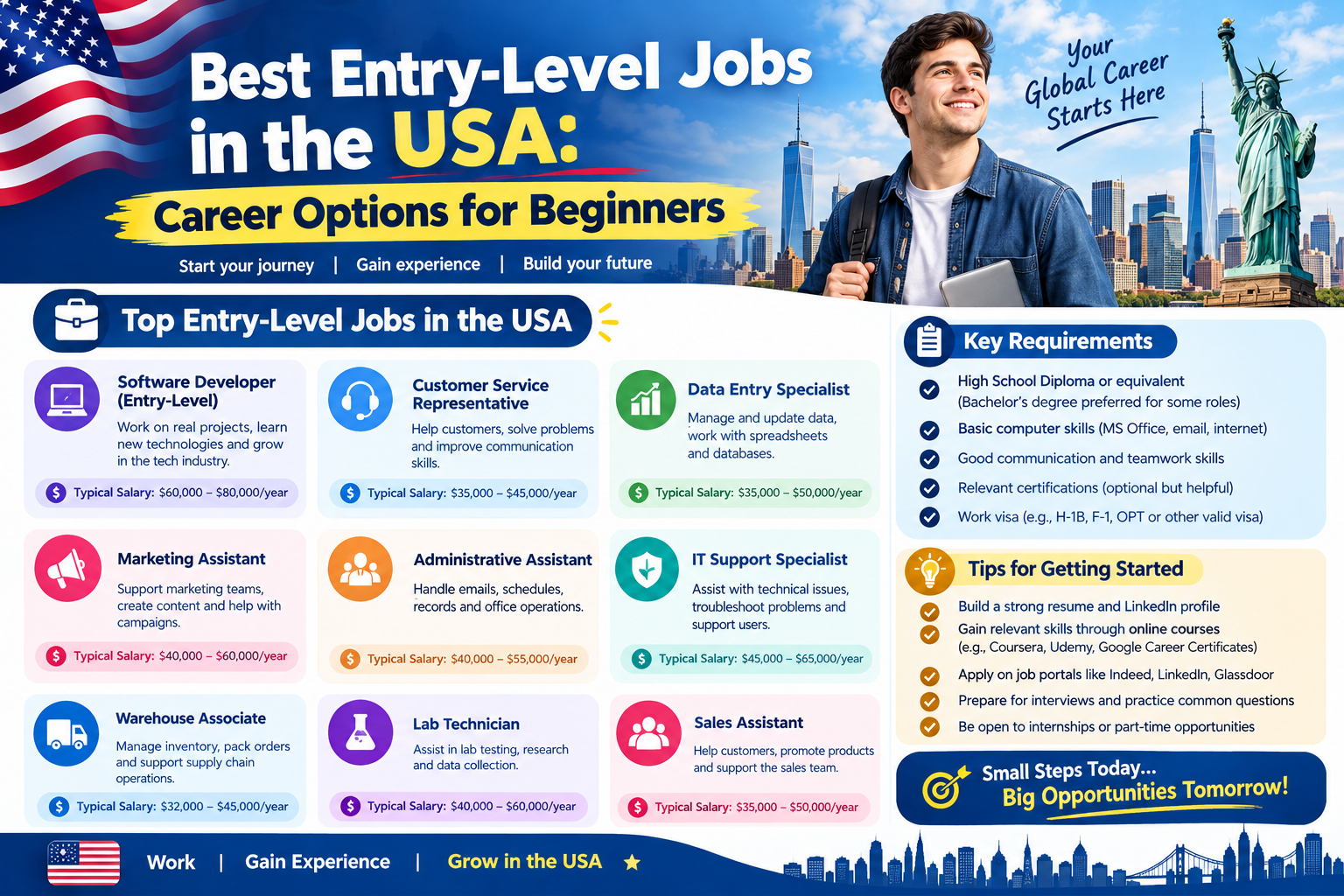
Starting a career can feel challenging when you have little or no professional experience. The good news is that the U.S. employment market includes many occupations designed around different levels of education, training, and experience. For beginners, the key is not simply finding a job with the word “entry-level” in the title, but identifying an occupation where your current education and skills provide a realistic starting point for building a career.
In 2026, the search for entry level jobs in USA can include opportunities in customer service, administration, healthcare, logistics, technology support, hospitality, skilled trades, sales, and many other fields.
According to the U.S. Bureau of Labor Statistics (BLS), occupations have different typical entry requirements. Some require no formal educational credential, while others typically require a high school diploma, postsecondary certificate, associate degree, or bachelor’s degree. BLS also notes that its classification reflects the typical preparation for an occupation and does not capture every possible route into a career.
This guide explains some of the career options beginners can consider, what employers may look for, and how to build experience when starting your career.
What Are Entry-Level Jobs?
An entry-level job is generally a position intended for people who are at the beginning of a particular career path. It may require little previous experience, although the exact meaning varies between employers and occupations.
Some entry-level positions provide on-the-job training. Others expect applicants to have a college degree, professional certificate, technical skills, or relevant education but do not require previous employment in the same occupation.
For example, an entry-level office position may require a high school diploma and basic computer skills, while an entry-level software position may require a bachelor’s degree and programming knowledge.
Therefore, “entry-level” does not always mean “no qualifications required.”
1. Customer Service Representative
Customer service is one of the most accessible career areas for people developing their first professional experience.
Customer service representatives may communicate with customers through:
- Phone
- Online chat
- In-person interactions
- Customer support systems
Typical responsibilities can include answering questions, resolving basic problems, updating customer records, processing requests, and explaining products or services.
Skills That Can Help
Employers may value:
- Clear communication
- Patience
- Listening skills
- Basic computer knowledge
- Problem-solving
- Professional behavior
- Time management
Customer service can also help beginners develop transferable skills that are useful in sales, administration, hospitality, account management, and other careers.
2. Administrative and Office Assistant Jobs
Administrative roles can provide beginners with experience in business environments.
Typical responsibilities may include:
- Managing schedules
- Organizing documents
- Answering calls
- Entering information
- Preparing basic reports
- Managing email
- Supporting office staff
Basic knowledge of office software can be useful.
Learning tools such as word processors, spreadsheets, calendars, email systems, and collaboration platforms can improve a beginner’s ability to compete for administrative positions.
3. Retail Jobs
Retail remains a common starting point for people entering the workforce.
Entry-level retail positions can include:
- Sales associate
- Store associate
- Cashier
- Stock associate
- Customer service associate
Responsibilities vary by employer but may include assisting customers, operating checkout systems, organizing products, maintaining displays, and handling basic inventory tasks.
Retail experience can help develop communication, teamwork, customer service, and time-management skills.
4. Warehouse and Order-Fulfillment Jobs
The growth of e-commerce and distribution networks has created many different logistics-related occupations.
Beginners may encounter positions involving:
- Order fulfillment
- Stocking
- Packing
- Shipping
- Receiving
- Inventory support
- Warehouse operations
BLS’s latest employment projections identify stockers and order fillers among the occupations projected to add substantial numbers of jobs during 2025–35.
Some warehouse positions provide employer training, while others may require experience with warehouse management systems or equipment.
5. Food Service and Hospitality Jobs
Hospitality can provide an accessible entry point for people developing their first work experience.
Potential roles include:
- Restaurant team member
- Host
- Server
- Kitchen assistant
- Cook
- Hotel front-desk associate
- Housekeeping staff
- Guest-service representative
Employers often emphasize reliability, communication, teamwork, customer service, and the ability to work in a busy environment.
Restaurant and food-service occupations also appear among the occupations with substantial projected job growth in the latest BLS projections.
6. Home Health and Personal Care Careers
Healthcare support is another area beginners may investigate, although specific training and eligibility requirements vary by occupation and state.
Home health and personal care aides assist people with daily living activities and provide certain forms of support in homes or other care settings.
BLS currently projects home health and personal care aides to have the largest numeric employment increase among occupations for 2025–35, with about 847,300 additional jobs projected.
This does not mean every position is suitable for every beginner. Candidates should check the employer’s training requirements, state rules, and the actual responsibilities of the position.
7. Medical Assistant Careers
Medical assisting can be an option for people interested in healthcare but who are not pursuing a physician or nursing career.
Medical assistants can perform administrative and clinical tasks depending on their workplace and responsibilities.
Possible duties include:
- Scheduling appointments
- Maintaining patient information
- Supporting healthcare professionals
- Preparing examination areas
- Taking basic measurements
- Handling administrative tasks
BLS projects medical assistants to add approximately 107,600 jobs from 2025 to 2035.
Training requirements vary, so beginners should research local employers and state requirements before choosing a program.
8. IT Support Jobs
Technology does not only offer software-development careers.
People starting in technology can explore roles such as:
- IT support specialist
- Help-desk technician
- Technical support specialist
- Computer support specialist
- Junior systems support
Depending on the occupation, employers may value troubleshooting ability, computer knowledge, communication, and familiarity with operating systems and software.
BLS’s 2025 education and training data lists computer user support specialists as typically requiring some college education but no degree, while computer network support specialists typically require an associate degree.
This illustrates why beginners should research the specific occupation rather than assuming every IT job has the same educational requirement.
9. Sales Jobs
Sales can be another career starting point, particularly for people who enjoy communication and working with customers.
Entry-level positions can include:
- Sales representative
- Retail sales associate
- Inside sales representative
- Business development representative
- Sales support
Important skills can include:
- Communication
- Listening
- Product knowledge
- Organization
- Customer relationship management
- Persuasion
- Goal management
Some sales roles use commission-based compensation, so applicants should understand the compensation structure before accepting an offer.
10. Skilled Trades
Not every career requires a traditional four-year college pathway.
Skilled trades can include:
- Electrician
- Plumber
- HVAC technician
- Carpenter
- Welder
- Maintenance technician
- Construction worker
Training may involve apprenticeships, technical programs, employer training, or other routes depending on the occupation and location.
BLS data shows that occupations can have very different combinations of education and on-the-job training. For example, plumbers, pipefitters, and steamfitters are listed with a high-school education as the typical entry education and apprenticeship training.
Some trades also have licensing requirements that vary by state.
11. Construction Jobs
Construction provides several potential starting points for people interested in practical and technical work.
Entry-level opportunities can include construction labor, site support, material handling, and certain trainee positions.
Construction laborers are among the occupations BLS projects to add more than 100,000 jobs between 2025 and 2035.
Beginners should pay attention to employer safety training and any certification requirements associated with specific equipment or duties.
Construction can also provide a pathway toward more specialized occupations as workers gain experience and training.
12. Delivery and Transportation Jobs
Transportation and delivery can provide another route into the workforce.
Potential positions vary from local delivery work to logistics support and transportation operations.
Requirements depend heavily on the role. Driving positions may require an appropriate driver’s license, and certain commercial driving occupations require additional qualifications.
BLS projects approximately 83,800 additional heavy and tractor-trailer truck driver jobs from 2025 to 2035.
Applicants should always verify the licensing requirements that apply to the specific driving position.
13. Accounting and Business Entry-Level Careers
A college degree can be required for some business occupations, but there are several ways to begin developing business experience.
Potential entry-level pathways include:
- Accounting assistant
- Bookkeeping support
- Administrative assistant
- Business support
- Sales support
- Marketing assistant
For professional business occupations, educational requirements can be higher. For example, BLS identifies accountants and auditors as occupations that typically require a bachelor’s degree.
The important point is to distinguish between a genuinely entry-level position and an occupation where “entry-level” still means a degree is required.
14. Marketing and Digital Content
Beginners with strong writing, communication, design, or digital skills can explore marketing-related positions.
Possible starting roles include:
- Marketing assistant
- Content assistant
- Social media assistant
- Junior marketing coordinator
- Email marketing assistant
A portfolio can be useful because it gives employers examples of actual work.
A beginner could build a portfolio through legitimate academic projects, personal projects, volunteer work, or other appropriate experience.
15. Data and Analytics Pathways
Data-related careers have different educational requirements.
Some analyst positions require a bachelor’s degree, while support or junior roles may have different requirements depending on the employer.
Useful skills can include:
- Excel or spreadsheet analysis
- SQL
- Data visualization
- Basic statistics
- Problem-solving
- Attention to detail
Candidates should read each job description carefully rather than assuming that all “data” jobs are accessible without a degree.
Entry-Level Jobs by Education Level
One useful way to search for jobs is to begin with the education you already have.
According to the latest BLS data, occupations are categorized according to their typical entry-level education. In 2025, occupations requiring a high school diploma or equivalent represented about 35% of employment, while occupations requiring no formal educational credential represented about 24%.
No Formal Educational Credential
Potential areas may include:
- Food service
- Some warehouse positions
- Certain cleaning and maintenance jobs
- Some labor occupations
- Selected service positions
High School Diploma
Potential areas may include:
- Customer service
- Administrative support
- Retail
- Logistics
- Office support
- Certain construction roles
Postsecondary Certificate
Some healthcare, technical, and trade careers may require a certificate or other postsecondary credential.
Associate Degree
Associate-level pathways can include certain technical, healthcare, and computer-support occupations.
Bachelor’s Degree
Many professional entry-level positions require a bachelor’s degree even when they do not require previous professional experience.
The latest BLS data shows that bachelor’s-degree occupations accounted for about 25% of employment in 2025.
How to Find Entry-Level Jobs in the USA
A focused search is usually more useful than applying to every vacancy.
1. Identify Your Skills
Make a list of:
- Education
- Technical skills
- Computer skills
- Communication skills
- Certifications
- Languages
- Previous experience
Even volunteer work, academic projects, internships, and practical projects can help demonstrate relevant abilities where appropriate.
2. Search Specific Job Titles
Instead of searching only for “entry level jobs in USA,” use specific combinations.
Examples include:
- Entry-level customer service jobs
- Entry-level IT support jobs
- Entry-level administrative jobs
- Entry-level warehouse jobs
- Entry-level healthcare jobs
- Entry-level accounting jobs
Adding a city or state can make the search more relevant.
3. Check Employer Career Pages
After finding an interesting company, visit its official careers page.
Look for:
- Entry-level positions
- Graduate opportunities
- Trainee roles
- Internships
- Apprenticeships
- Junior positions
4. Customize Your Resume
Your resume should emphasize the experience most relevant to the vacancy.
If the job requires customer communication, highlight communication and service experience.
If it requires spreadsheets, mention relevant spreadsheet skills.
If it requires technical knowledge, make those skills easy to find.
What Employers Look for in Beginners
Employers hiring beginners cannot always expect years of experience.
They may instead look for evidence of:
- Reliability
- Willingness to learn
- Communication
- Teamwork
- Problem-solving
- Basic technical skills
- Professional behavior
- Adaptability
Your application should demonstrate these qualities through actual examples rather than relying only on generic words.
How to Gain Experience Before Your First Job
If you are struggling because job advertisements ask for experience, consider ways to demonstrate practical ability.
Depending on your field, you can build experience through:
- Internships
- Apprenticeships
- Academic projects
- Personal projects
- Volunteer activities
- Short-term training
- Certifications
- Portfolio work
For example, someone interested in web development can create several legitimate demonstration projects. Someone interested in administration can develop spreadsheet and office-software skills.
Entry-Level Jobs and Career Growth
An entry-level job does not have to be your final career destination.
A first job can help you develop:
- Professional communication
- Industry knowledge
- Workplace experience
- Technical skills
- Professional contacts
- Confidence
- A record of measurable achievements
After gaining experience, you may be able to move into more specialized or higher-responsibility positions.
For example:
Customer Service Representative → Senior Representative → Team Lead → Customer Service Manager
or
IT Support → Technical Support Specialist → Systems Administrator → IT Manager
The actual progression varies by industry and employer.
Important Tips for Job Beginners
Read the Full Job Description
Do not apply solely because the title says “entry-level.”
Check education, experience, schedule, location, skills, and other requirements.
Avoid Unrealistic Job Offers
Be cautious of advertisements promising unusually high income with almost no qualifications or effort.
Never Misrepresent Your Experience
If you do not have professional experience, emphasize relevant education, projects, training, and transferable skills instead.
Research the Employer
Verify the company and vacancy through reliable sources before providing sensitive information.
Keep Track of Applications
Maintain a simple spreadsheet with:
- Company
- Position
- Application date
- Location
- Job link
- Status
- Interview date
- Notes
This makes a large job search easier to manage.
Frequently Asked Questions
What are the best entry-level jobs in the USA?
There is no single best job for every beginner. Customer service, administration, retail, logistics, hospitality, healthcare support, IT support, skilled trades, construction, sales, and other fields can provide different starting points depending on education and skills.
Can I get an entry-level job without experience?
Yes. Some occupations typically require little or no previous experience, although employers may still look for education, training, skills, or personal qualities relevant to the job.
Do entry-level jobs require a college degree?
Not always. BLS data shows that occupations have different typical educational requirements, ranging from no formal credential to postgraduate education.
Are entry-level jobs available for people without a high school diploma?
Some occupations typically do not require a formal educational credential. However, requirements vary by employer and position, so each vacancy should be reviewed individually.
Can entry-level jobs lead to better careers?
Yes. Many people use their first job to gain experience, develop skills, and qualify for more specialized responsibilities.
Final Thoughts
Finding entry level jobs in USA becomes much easier when you approach the process according to your current education, skills, experience, and career goals.
Beginners can explore customer service, office administration, retail, logistics, hospitality, healthcare support, IT support, construction, skilled trades, sales, marketing, and other areas. The right choice depends on the requirements of the specific occupation and what you want to develop over the next few years.
Current BLS employment data also shows that many occupations with different education levels are expected to add jobs over the 2025–35 period, while the number of projected openings varies substantially by occupation.
Rather than searching only for the highest-paying job or the job with the easiest requirements, beginners should look for a realistic starting position that provides useful experience and opportunities to develop transferable skills.
With a targeted resume, relevant skills, careful employer research, and consistent applications, an entry-level position can become the first step toward a much broader career in the United States.